Mar 19, 2026
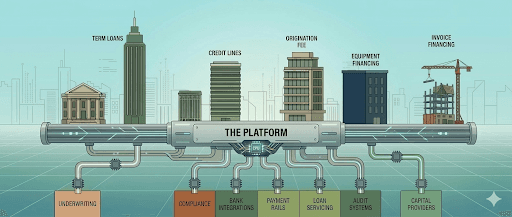
In the first article in this series, I discussed why underwriting is only a piece of the SMB lending puzzle. The harder problem is building the regulated infrastructure required to operate conventional lending products reliably over time.
In the second article, I discussed what becomes possible once that infrastructure exists. A platform that can operate one regulated lending product can typically support many others with relatively small incremental effort.
The remaining question is why this matters.
Infrastructure Determines the Shape of the Market
In fintech lending, most companies begin with a product.
They design an underwriting model, choose a loan structure, and build just enough operational capability to support that product. For many early fintech companies, merchant cash advances became the natural choice because they simplify the regulatory and operational environment.
That approach can work well for launching a product quickly.
It does not produce a lending platform.
A lending platform emerges when infrastructure is built first and products are layered on top of it.
Regulatory compliance, bank partner integration, payment orchestration, and lifecycle auditability are difficult systems to build correctly. Once they exist, however, they form the foundation for many different lending products.
When the underlying infrastructure exists, expanding the product set becomes significantly easier.
Infrastructure Enables Embedded Finance
The rise of embedded finance has amplified the importance of lending infrastructure.
When lending is distributed through partner platforms, the operational requirements change. Systems must integrate cleanly with partner applications, support multiple product configurations, and operate reliably without manual intervention.
Embedded lending also introduces additional complexity:
multiple partner integrations
varying borrower acquisition channels
auditability
different capital providers
evolving regulatory requirements
Without strong infrastructure, these systems quickly become fragile.
Infrastructure allows lending capabilities to be delivered as a platform rather than as a single product.
Partners can integrate through APIs, embedded experiences, or fully white-labeled applications while relying on the same underlying operational systems.
Infrastructure Compounds
The most important property of infrastructure is that it compounds.
Each new product added to the platform inherits the systems that already exist. Each new partner benefits from integrations that have already been solved. Each regulatory approval or bank partnership expands the set of opportunities the platform can support.
Over time, this creates a widening gap between companies that built infrastructure early and those that focused only on individual products.
Products can be replicated.
Infrastructure is much harder to reproduce.
Solving the Right Problem
Fintech lending discussions often return to underwriting models, machine learning techniques, or data access.
Those are important components of a lending system.
They are not the system itself.
Reliable SMB lending requires infrastructure that can coordinate financial institutions, payment networks, regulatory frameworks, and partner platforms over the full life of a loan.
Building that infrastructure correctly takes time.
Once it exists, however, it becomes the foundation on which a broader set of lending products can be supported.
Want to learn more? Click here to schedule a demo.