Mar 17, 2026
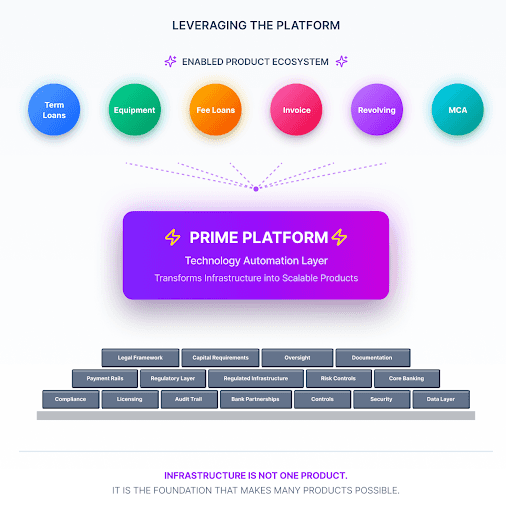
In a previous article I discussed why underwriting is only one piece of the SMB lending puzzle, and why the harder problem is building the regulated infrastructure required to operate conventional term loans reliably over time.
That infrastructure includes the compliance frameworks, bank partnerships, payment rail integrations, and audit systems required to operate regulated lending programs. Building those systems correctly takes significant time and engineering effort.
The more interesting question is what becomes possible once it exists.
What the Infrastructure Unlocks
Building regulated lending infrastructure is not a product decision. It is a platform decision.
The compliance frameworks, state licensing, and financial controls required to operate a term loan are the same ones required to operate equipment financing, origination-fee-based loans, and revolving lines of credit. The foundational work does not need to be repeated for each new product. It needs to be done once, and done correctly.
This is what separates a lending platform from a lending product. Prime has built the former.
The products Prime can offer today reflect this directly. Traditional term loans and equipment financing are natural expressions of the core infrastructure: asset-backed where appropriate, APR-based throughout, and structured to provide SMBs with financing at a fraction of the effective cost of MCA alternatives.
Origination-fee-based loans extend that capability further, providing a viable option for borrowers who fall outside standard term loan criteria without defaulting to the extravagant rates that characterize MCA products.
The product surface does not stop there.
Invoice financing, revolving lines of credit, and even MCAs where appropriate all become viable options on top of the same infrastructure. The regulatory and operational foundation that makes conventional lending possible is the same foundation that supports the full spectrum of lending products.
The infrastructure does not constrain the product roadmap. It enables it.
How Partners Access the Platform
Prime's platform is designed to meet partners where they are.
Because every product and integration point is built on top of the same core API, partners have genuine flexibility in how they connect.
Partners can integrate with the platform at whatever depth makes sense for their business.
For partners who want to move quickly with minimal engineering investment, Prime offers a fully white-labeled front-end application. Partners provide their assets and branding, and the platform handles the rest. No custom development is required.
For partners who want tighter integration with their existing applications, Prime offers a lightweight embeddable widget. A small amount of JavaScript is all that is required to surface Prime's lending capabilities directly within a partner's own product experience.
For partners who want full control, the same API that powers both of those solutions is available directly. Custom applications, proprietary workflows, and bespoke user experiences are all achievable without sacrificing access to the underlying platform capabilities.
This flexibility is not incidental. It is a direct consequence of the domain-oriented architecture described in the previous article.
Because Prime's services own their own data models and expose independent APIs, partners can integrate at whatever depth makes sense for their use case. Fraud and underwriting can be accessed independently. Open banking and money movement services stand alone.
A partner who needs only one capability does not inherit the complexity of the entire lending stack to access it.
The Compounding Value of Infrastructure
Infrastructure of this kind compounds over time in ways that individual products do not.
Every new lending product inherits the infrastructure that already exists.
Each product added to the platform benefits from the same compliance framework, bank partnerships, audit trail, and operational controls that are already in place. The marginal cost of expanding the product surface decreases as the platform matures.
At the same time, the value of the platform to partners increases as the range of addressable use cases grows.
For partners, this means access to lending capabilities that would take years to build independently, available today across multiple integration paths and an expanding set of
products.
For the SMBs they serve, it means access to regulated, fairly priced financial products that the infrastructure of early fintech lending was never designed to support.
That is what becomes possible when the infrastructure is already built.
Want to learn more? Click here to schedule a demo.