By Prime FT
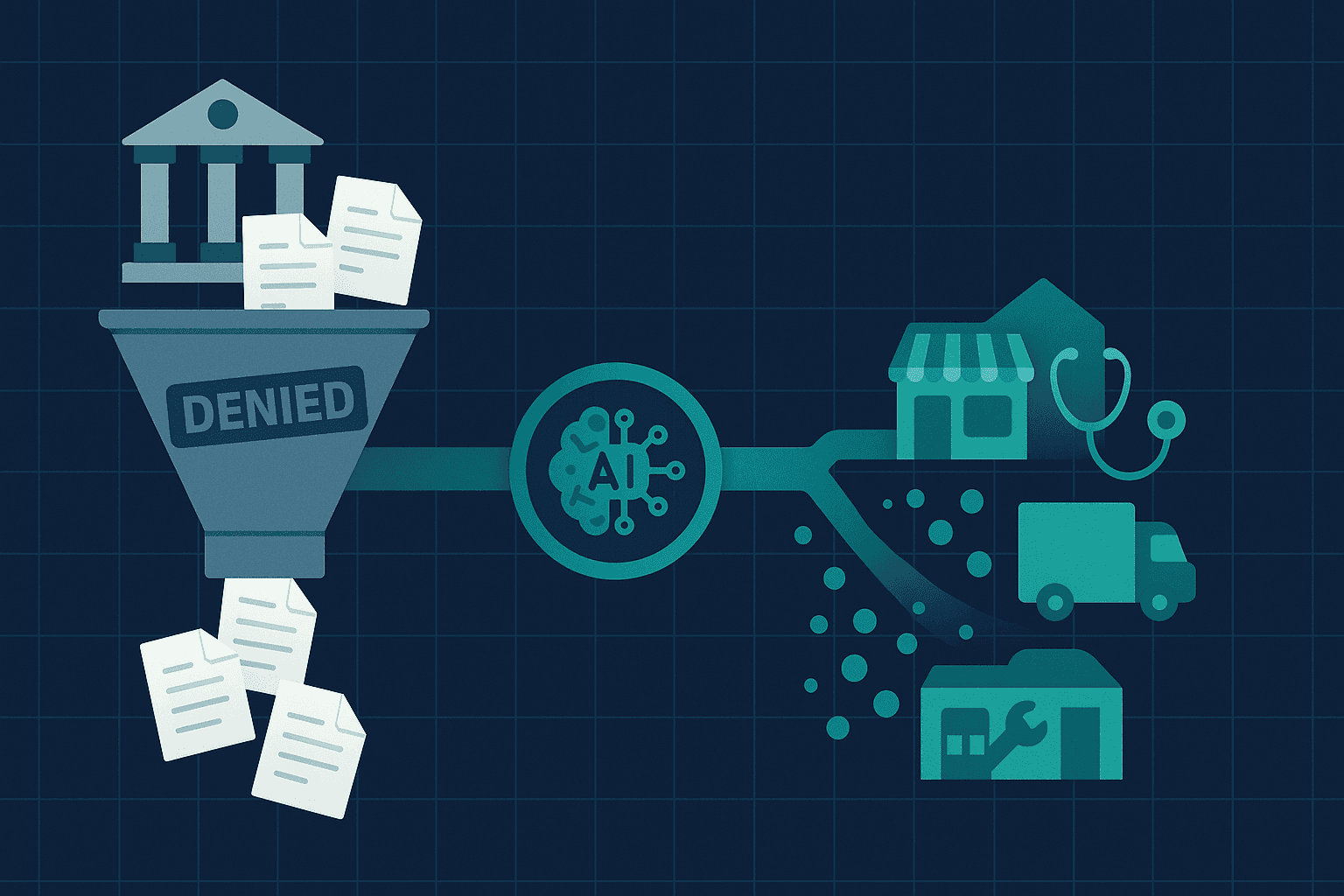
The Capital Gap: Why Banks Say “No”
Although access to capital is often invoked as the top barrier for small businesses, this isn’t just rhetoric. A 2025 survey of small-business resource organizations found that “challenges with access to credit and capital” were among the most frequently cited issues. In a more direct measure, a Goldman Sachs “10,000 Small Businesses Voices” survey observed that 81% of small business owners who applied for a loan or line of credit in the prior year said it was difficult to access affordable capital.
Why do banks say “no”? According to multiple banking surveys, some of the most common reasons are:
Weak financials / cash flow concerns: In a 2024 Kansas City Fed survey, approximately 70% of respondents said borrower financials were the top reason for denying a loan.
Credit history / score issues: Low or limited credit has long been a barrier. SMBs are rejected because of credit score issues. Often creditors look at not only your personal credit, but also your business credit.
Insufficient collateral or guarantees: Many small or new businesses lack the assets needed to secure a loan.
High debt burden / debt service capacity: Even if debt itself isn’t excessive, lenders often worry whether a business can manage additional payment obligations.
Risk aversion and tightening standards: Economic uncertainty, rising interest rates, and regulatory pressure lead banks to tighten credit, reducing risk appetite for “marginal” borrowers.
Underwriting inertia / reliance on traditional metrics: Many banks still rely heavily on legacy credit score models, static balance sheets, and relationship-based assessments, which may overlook strong but unconventional businesses.
The result is that many creditworthy SMBs do not get funded. Not because they lack potential, but because they fail to check all the boxes in traditional bank underwriting.
Cash Flow Realities for Growing Companies
Growth is often capital-intensive. Businesses need to stock up, hire ahead of demand, renovate or expand premises, or bridge seasonal revenue lags. Even companies with solid gross margins may struggle with timing mismatches between receivables, payables, and fixed costs.
Indeed, a common finding is that businesses frequently do not apply for credit because they believe they will be denied. In one survey, 44% of small and medium businesses said they avoided applying for a loan because they felt they would be turned down.
Meanwhile, among those who do apply, many find they receive only partial funding or none at all. These dynamics force businesses to rely on short-term fixes, such as credit cards, personal funds, or delayed payments to vendors, which are neither scalable nor sustainable.
The Impact of Limited Funding on Local Economies
Small businesses are critical to local economies: job creation, local reinvestment, community services, and vitality of neighborhoods. When access to capital is constrained:
Expansion slows or halts
New business formation becomes riskier
Owners may be forced to under-invest in technology, staff, or infrastructure
Local tax bases and consumer services may stagnate
In fact, a 2025 Goldman Sachs press release noted that 49% of small businesses had to halt expansion projects and 41% limited new business because funding was not available or affordable.
By contrast, when capital flows, new business investment, hiring, and innovation are more active, and those effects are disproportionately felt in local economies outside major metro hubs.
How Fintechs Are Filling the Gap
Fintech lenders are redefining business credit through data, automation, and alternative risk modeling. Here’s how they are bridging the gap:
Dynamic underwriting using real-time data
Rather than relying solely on credit history, fintechs can ingest transaction data, invoicing trends, cash flow trajectories, and even platform data (e.g., e-commerce, payment rails) to model business health.Faster decision-making and capital delivery
Many fintech platforms can approve and disburse funds within minutes or hours, aligning with business needs and outpacing legacy bank timelines.Flexible products and risk-sharing
Fintechs often offer shorter-term, incremental, or revenue-based repayment products that carry risk structures more acceptable to modern small businesses.Improved inclusion and lower barriers
By shifting away from rigid credit thresholds, fintechs can serve startups, minority-owned businesses, or nontraditional business models more readily.Partnerships with banks and capital providers
Many fintechs act as originators or credit enhancers, enabling banks or institutional capital to reach borrowers they would otherwise reject.Seamless access through embedded finance
By integrating lending directly into digital ecosystems, fintechs allow businesses to access capital where they already work — simplifying applications, accelerating approvals, and expanding financial inclusion.
Don’t let limited funding hold your customers back. Prime leverages AI-driven assessments to expand the evaluation envelope. Instead of rejecting a business based on a single weak metric, Prime can synthesize multiple signals to assess viability. This helps more SMBs qualify for capital.
Discover how Prime unlocks new capital for your customers. Click here to schedule a demo.